
How To Not Become a Billionaire
Jesus's teaching on how to deal with wealth, and a stunning modern exemplar. Marginal Theology pt 5

I’ve now read this story in several different translations, because the lesson feels so obvious to me that I’m confused how I didn’t hear it growing up in my southern Baptist church. But of course, I know why. Let’s dive in:

The Parable of the Dishonest Manager
Luke 16:1-13 NRSV,A
16 Then Jesus[a] said to the disciples, ‘There was a rich man who had a manager, and charges were brought to him that this man was squandering his property. 2 So he summoned him and said to him, “What is this that I hear about you? Give me an account of your management, because you cannot be my manager any longer.” 3 Then the manager said to himself, “What will I do, now that my master is taking the position away from me? I am not strong enough to dig, and I am ashamed to beg. 4 I have decided what to do so that, when I am dismissed as manager, people may welcome me into their homes.” 5 So, summoning his master’s debtors one by one, he asked the first, “How much do you owe my master?” 6 He answered, “A hundred jugs of olive oil.” He said to him, “Take your bill, sit down quickly, and make it fifty.” 7 Then he asked another, “And how much do you owe?” He replied, “A hundred containers of wheat.” He said to him, “Take your bill and make it eighty.” 8 And his master commended the dishonest manager because he had acted shrewdly; for the children of this age are more shrewd in dealing with their own generation than are the children of light. 9 And I tell you, make friends for yourselves by means of dishonest wealth[b] so that when it is gone, they may welcome you into the eternal homes.[c]
10 ‘Whoever is faithful in a very little is faithful also in much; and whoever is dishonest in a very little is dishonest also in much. 11 If then you have not been faithful with the dishonest wealth,[d] who will entrust to you the true riches? 12 And if you have not been faithful with what belongs to another, who will give you what is your own? 13 No slave can serve two masters; for a slave will either hate the one and love the other, or be devoted to the one and despise the other. You cannot serve God and wealth.’[e]
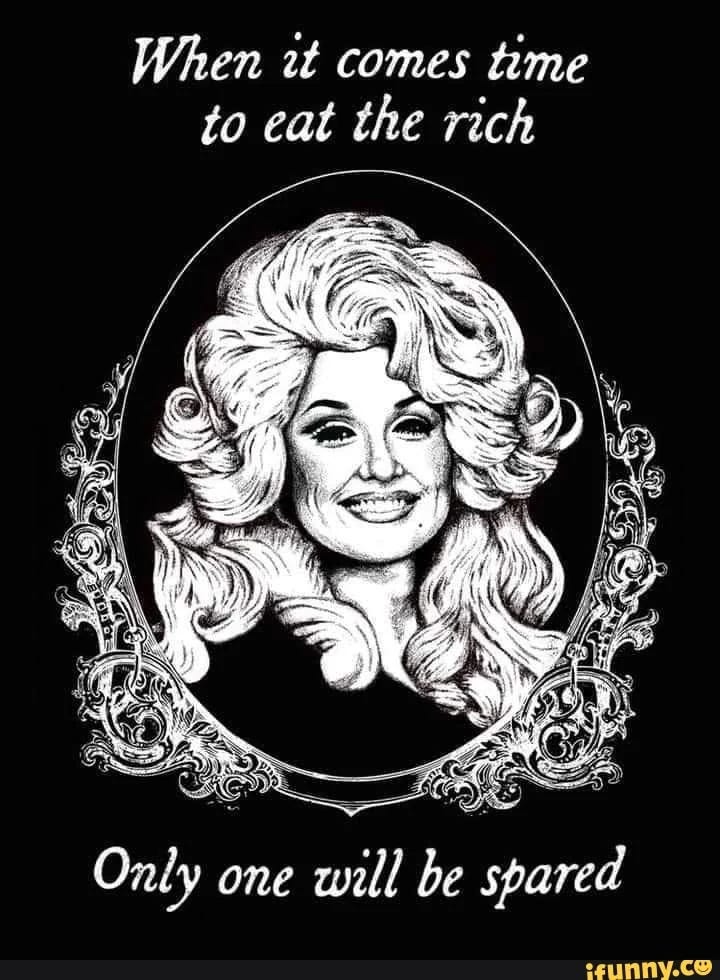
When It’s Time to Eat The Rich, Only One Will Be Spared
When I was a kid, my dad took me to an education conference he attended most winters. One year it was in Orlando, and I got to go to Disney World, so pumped. When I was 13, though, the conference was in San Diego, CA and he brought be along for my birthday. I go to go to LegoLand and check out the Pacific Ocean for the first time. I also have distinct memories of seeing the movies Rollerball, and Milk (guess who picked which movie, haha). But one of the most memorable moments of the trip was when my dad dragged me to the end note speaker of the conference: Dolly Parton.
“You have to see her, Abi, you’re going to love it,” my dad encouraged me. But, of course, I was a dumb 13 year old and didn’t understand who was standing on that stage. Despite my ignorance I enjoyed the talk, and I even laughed at a few of her jokes (any parent of a teen knows how rare a genuine laugh from a 13 year old can be). My dad explained to me how famous and important a person Dolly was (and is), but even then, I couldn’t for the life of me understand why someone so famous would be speaking at this random conference on education.
As it turns out, Dolly Parton has likely done more good for American education than any single individual in our country’s history. Through her Imagination Library and Dollywood Foundation she has donated hundreds of millions of dollars to support childhood literacy and education across the world. She set up Dollywood, her theme parks, to provide steady, secure jobs for people in her home state. When Whitney Houston sang her song, “I Will Always Love You,” Dolly invested all the royalties from the song to poor Black communities in Tennessee. Don’t forget how she saved all our asses by supporting COVID vaccine research through Moderna! I was so proud to get the Dolly vaccine when it finally arrived. It seems like every time she turns around, she’s giving more money to the people who need it.
And the financial facts back that up. In 2017, Dolly’s net worth was estimated at 500 million dollars. Today, her net worth is estimated between 600-650 million dollars. This is remarkable when you remember that from 2020-2025 we’ve seen more people become billionaires than in any other time. The rich get richer as they say. But Parton’s net worth increase is modest at best, and certainly hasn’t kept up with inflation. This is a testament to her philanthropy work. Dolly gives money away like a sailor frantically scooping out buckets of water in a lifeboat that’s sprung a leak. The only reason Dolly is not a Billionaire is because she’s been giving her money away from the beginning.
Who’s the Master?
The story Jesus shares in Luke 16 can be confusing. He calls the manager dishonest (or shrewd in some other translations), shouldn’t the manager be the bad guy in the story? The manager should have gotten fired for not managing his master’s property well, right? Then he goes on to screw over his master even more! But then Jesus is commending him? WHAT?!
Growing up in the church, there was this habit of translation that any time Jesus told a parable that had a “master” the master was G*d. When you see the master in this story as G*d, it does not make sense. You have to do a lot of mental and theological gymnastics to get a decent sermon out of it, so I honestly think most folks skip it, or put in the work on the mental-emotional-theological pummel horse and come up with something too convoluted to be helpful to anyone. If, though, we bring in some more cultural context and drop the idea that every time Jesus talks about a master he’s talking about G*d, we get a better peak into what Jesus was getting at.
It’s important to note that Jesus calls the master the same thing he called the manager, shrewd or dishonest. Even at that time, the hoarding of wealth was distasteful at best, and an all out abomination at worst. If someone was hoarding wealth, be it the Roman Emperor, or the Pharisees, it was clear to the common person that it was only because they were exploiting those under their care—they weren’t doing their part to support those who needed it. So, when Jesus starts off this story and calls both the manager and the master shrewd or dishonest, there is an understanding that neither of these people start out as a “good guy.”
When you consider the last verse in this passage, you start to see that the master Jesus is talking about in this story isn’t G*d, but is something else, something that will leave you empty handed.
Some Things Never Change
Just like now, Jesus lived at a time when the system was broken. The focus on amassing wealth for one’s own personal gain was destroying the fabric of society. The rich were getting richer, and the poor were getting poorer. Just like now, there were a lot of people who thought they could work their way into safety by working for the system—people like the manager in the story.
I like to give this guy a little more backstory, because it makes it more interesting. He’s a real rags to riches type, worked his way up the ladder, wheelin-and-dealin, playing the game, until he was the manager. He was shrewd and it got him pretty far, but then his dream was taken away from him. He woke up and realized that the system wasn’t going to protect him. So, what did he do? He decided to do a little damage of his own, and hopefully make some friends along the way.
Even though this parable can feel a little convoluted, Jesus sums it up by saying, “And I tell you, make friends for yourselves by means of dishonest wealth[b] so that when it is gone, they may welcome you into the eternal homes,” or from the NLT, “Here’s the lesson: Use your worldly resources to benefit others and make friends. Then, when your possessions are gone, they will welcome you to an eternal home.” Basically: money, wealth, riches are all meant to be shared—because they won’t last, but relationships, connection, community, those are forever.
In A World Full of Elons, Be A Dolly
When we tried to find our sense of security in wealth, we will always be disappointed, and we will more than likely end up acting more shrewdly than we know ourselves to be. No amount of money will fill the hole in your heart, and there are several people on this planet that are really trying, and failing spectacularly. But when we invest our wealth in people, something magical happens.
Now, don’t get me wrong, Dolly Parton is rich. Like, life-changingly rich. But when you consider both the length and magnitude of her career, she certainly isn’t as rich as she should be. Easily one of the most successful recording artists of all time, with a career spanning nearly 75 years, if Dolly had dealt with her money they way most in her position do, she would have likely been the first self-made, female billionaire. But she didn’t. She invested her wealth in people, instead of investing her security in her wealth. This is exactly what Jesus is telling us to do.
At the end of the passage Jesus brings the real mic-drop moment with one of the most quoted and most ignored passages in the bible: “No one can serve two masters. Either you will hate the one and love the other, or you will be devoted to the one and despise the other. You cannot serve both God and money.”
The master the manager was serving in the story was money, something that will always leave you high and dry. It will always run out, and if that’s what you’re investing all your security into, Jesus is clear that you will be disappointed. When we elevate wealth to the level of master, we end up disregarding and despising the relationships, community, and connection that actually offer us a meaningful life. But, when we use our worldly resources to invest in the people and things who need it, we find our everlasting support and comfort in each other—just as G*d intended.
🙌
AMEN